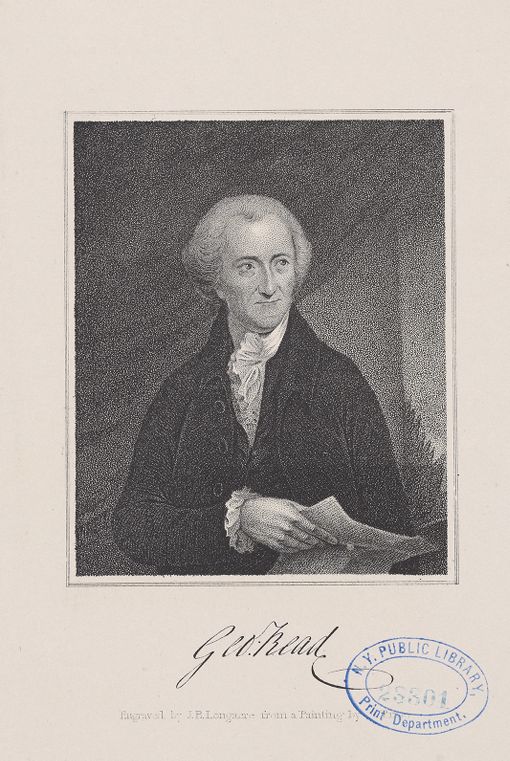
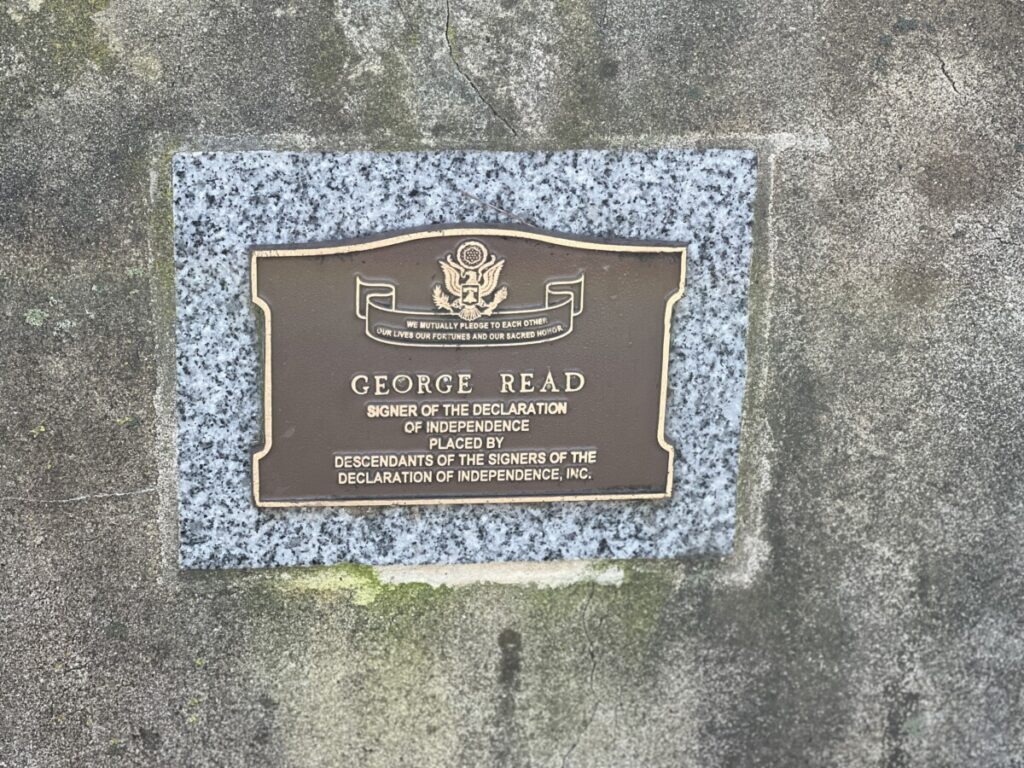
George Read
Signer of the Declaration of Independence
Birth and Family Background
George Read was born on September 18, 1733, on his family’s estate in Cecil County, Maryland, near the border of Delaware. He was the eldest son of Colonel John Read, a respected landowner and public figure who had emigrated from Dublin, Ireland, and Mary Howell Read.
The Read family was proud of its long heritage, tracing its roots back to England and even to medieval nobility. George grew up in a household that valued education, refinement, and public service—qualities that would define his own life.
He received a classical education under the guidance of Dr. Francis Allison, a well-known educator of the time. After completing his early studies, Read turned to the law, which was one of the most respected professions in the colonies.
Legal Career and Marriage
George Read traveled to Philadelphia to study law and was admitted to the bar at the young age of nineteen. He soon established himself as a capable attorney and moved to New Castle, Delaware, in 1754, where he built a successful legal practice.
In 1763, Read married Gertrude Ross, the daughter of the Reverend George Ross of Immanuel Church in New Castle. The Ross family was one of the most prominent and respected families in the region. Several of Gertrude’s brothers held important positions, including George Ross, who would also become a signer of the Declaration of Independence.
The marriage strengthened Read’s standing in the community and connected him to a powerful political network. George and Gertrude had four children—three sons and one daughter. Their sons would go on to distinguished careers, including government and diplomatic service.
Early Public Service and Attorney General
George Read’s talents were recognized early in his career. At the age of twenty-nine, he was appointed Attorney General for the Delaware colonies under the British crown.
Even while serving the colonial government, Read showed a thoughtful and forward-looking political mind. In correspondence with British officials, he warned that taxing the colonies without representation would lead to serious consequences. Remarkably, he predicted more than a decade before the Declaration of Independence that such policies could lead the colonies to break away from Britain and eventually surpass England economically.
When it became clear that British policy would not change, Read resigned his royal appointment. He chose instead to stand with the American colonies and accepted a position in the First Continental Congress in 1774.
Continental Congress and the Question of Independence
George Read was a natural diplomat and a cautious political thinker. Even as tensions between Britain and the colonies escalated, he hoped for reconciliation rather than an immediate break.
When the issue of independence came before Congress in 1776, Read voted against the initial motion for independence. He believed the colonies were not yet ready for such a dramatic step and feared the consequences of acting too quickly.
However, once it became clear that reconciliation with Britain was impossible, Read accepted the decision of Congress. He signed the Declaration of Independence and became a committed supporter of the American cause.
He even introduced a strong resolution in Congress declaring that anyone who violated the agreement for independence should be publicly branded as a traitor. This showed that once he committed to the cause, he did so wholeheartedly.
Sacrifices During the Revolutionary War
Like many signers of the Declaration, George Read paid a personal price for his commitment to independence.
During the Revolutionary War:
- His home was confiscated by British forces.
- His wife was taken captive.
- He was forced to move from place to place for six years to avoid capture.
These hardships reflected the real dangers faced by the nation’s founders and their families.
Architect of Delaware’s Government
George Read played a central role in shaping the new state of Delaware. He was:
- The author of Delaware’s first state constitution in 1776
- A key figure in drafting the state’s early laws
- A longtime member of the Delaware Assembly, serving for twelve years
- Vice President of Delaware (a role similar to lieutenant governor)
- At one point, the acting chief magistrate of the state
Because of his deep involvement in Delaware’s political development, some historians consider him “the father of the State of Delaware.”
National Service and the Constitutional Convention
After the Revolutionary War, George Read continued his service at the national level.
He was appointed in 1782 as a judge in the National Court of Appeals in Admiralty, one of the early federal judicial bodies. In 1785, he served as a commissioner in a federal court that settled a territorial dispute between New York and Massachusetts.
In 1786, Read attended the Annapolis Convention, which helped lay the groundwork for the Constitutional Convention the following year.
At the Constitutional Convention of 1787 in Philadelphia, Read played an active and sometimes bold role. He was a strong supporter of a powerful national government and even proposed abolishing the states entirely in favor of one centralized authority—an idea that shocked many delegates.
Although that idea gained no support, Read remained influential. He became a strong defender of the rights of smaller states, warning that large states might dominate the union. He insisted on equal representation in the Senate and even threatened to withdraw the Delaware delegation if small states were not protected.
His efforts helped shape the Great Compromise, which created a Senate with equal representation for each state.
U.S. Senator and Chief Justice
After the Constitution was adopted, Delaware became the first state to ratify it, largely under Read’s leadership.
He was then elected as one of Delaware’s first United States Senators. He served one full term and was re-elected to a second.
In 1793, Read resigned from the Senate to accept the position of Chief Justice of Delaware. He served in that role until his death. As Chief Justice, he earned widespread respect for:
- His deep legal knowledge
- His sound judgment
- His integrity and fairness
Even those who disagreed with his decisions believed he acted out of a sincere sense of duty.
Personal Character and Social Life
George Read was known as a man of elegance and refinement. He dressed carefully and carried himself with dignity. On the day he signed the Declaration of Independence, he reportedly wore amethyst-studded shoe buckles, reflecting his attention to detail and style.
His home in New Castle, Delaware, became a center of hospitality. Many leading figures of the Revolution, including George Washington, stayed there. The house was known for its gracious atmosphere and lively gatherings of political and military leaders.
Read was also known for his generosity and loyalty to friends. He remained a strong supporter of John Dickinson, the “Penman of the Revolution,” even when Dickinson’s refusal to sign the Declaration made him unpopular. Through Read’s influence, Dickinson eventually regained his public standing.
Death and Burial
George Read died on September 21, 1798, just three days after his 65th birthday.
He was buried in the quiet churchyard of Immanuel Church in New Castle, Delaware, where generations of the Read family are also laid to rest. He had been a devoted member and warden of the Episcopal Church for many years.
Legacy and Historical Significance
George Read holds a unique place among the Founding Fathers. He was:
- A signer of the 1774 Petition to the King
- A signer of the Declaration of Independence
- A signer of the United States Constitution
He was the only southern statesman to sign all three of these foundational documents.
His career included service as:
- Colonial Attorney General
- Delegate to the Continental Congress
- Author of Delaware’s first constitution
- Vice President and acting chief magistrate of Delaware
- Delegate to the Constitutional Convention
- U.S. Senator
- Chief Justice of Delaware
George Read’s life reflected the steady, thoughtful leadership that guided the colonies through the revolution and into nationhood. Though less famous than some of his contemporaries, his influence on Delaware and the United States was profound.
He stands as a symbol of careful judgment, loyalty, and dedication to the principles that shaped the early American republic.


Leave a Reply