Edward Telfair (1735–1807)
A Scottish Immigrant Who Became a Patriot of Georgia
Edward Telfair was one of the important political leaders of Revolutionary-era Georgia and a signer of the Articles of Confederation, the young nation’s first governing document.
Born in Scotland and arriving in America as a young merchant seeking opportunity, Telfair rose to prominence as a successful businessman, revolutionary patriot, Continental Congressman, and three-term governor of Georgia.
His life reflects the classic story of an immigrant who embraced the American cause and helped shape the early republic.
Birth and Early Life in Scotland
Edward Telfair was born in 1735 in the village of Kirkcudbright, Scotland, a coastal town in the southwestern part of the country. His early life was modest, and he received only a limited elementary education, typical for many young men of his background during the eighteenth century.
Rather than pursuing extended schooling, Telfair entered the world of commerce at a young age. He took a position with a merchant trading firm, where he learned the practical skills of trade, shipping, and business management. This early experience would later prove invaluable in America, where mercantile trade was one of the primary engines of colonial prosperity.
Like many ambitious young Scots of the era, Telfair looked across the Atlantic to the American colonies as a place of opportunity. The expanding port cities of the colonies offered the promise of wealth, independence, and social advancement that was often difficult to achieve in Europe.
In 1758, Edward Telfair made the bold decision to leave Scotland and sail for America. He did not make the journey alone—his brother William Telfair had already traveled ahead and was pursuing opportunities in the colonies. With hopes of building a successful future, Edward crossed the Atlantic to begin a new life.

Arrival in America and Rise as a Merchant
After arriving in the colonies, Telfair initially spent some time in North Carolina. Eventually, however, he joined his brother William Telfair in the thriving port city of Savannah, Georgia, in 1766.
Savannah was a rapidly growing commercial center at the time, and the Telfair brothers quickly recognized the opportunities available there. Edward and William entered into a partnership with another Scotsman, Basil Cowper, forming a merchant trading business.
The venture proved highly successful. Through commerce, shipping, and trade with Britain and the Caribbean, Edward Telfair soon became one of the most prosperous merchants in colonial Georgia.
In addition to his mercantile success, Telfair invested in land. He acquired property in Burke County, Georgia, where he operated:
- A plantation worked by enslaved laborers
- A sawmill business
- Timber operations supported by the extensive forests on his land
The lumber industry proved particularly profitable. Timber from his plantations provided a steady supply of materials for his sawmill, helping to expand his wealth and influence in the region.
By the late 1760s, Edward Telfair had established himself as a prominent figure in Savannah’s commercial and civic life.
Entry into Colonial Politics
Telfair’s growing success and reputation led naturally to involvement in politics.
In 1768, only two years after settling permanently in Savannah, he was elected to the Georgia Commons House of Assembly, the colony’s legislative body.
His political career developed during a time of increasing tension between the American colonies and Great Britain. British policies such as the Stamp Act and other taxation measures were deeply unpopular among many colonists.
Like many leaders in Savannah, Telfair became increasingly sympathetic to the growing resistance movement.
Revolutionary Activity and the Sons of Liberty
As the conflict with Britain intensified, Edward Telfair became actively involved in the revolutionary movement in Georgia.
He joined the Sons of Liberty, a colonial organization dedicated to resisting British authority and organizing opposition to unpopular laws and taxes.
One of the most dramatic events of his early involvement in the revolution occurred in May 1775. News had just arrived in Savannah of the battles of Lexington and Concord, the first armed conflicts of the American Revolution.
In response, Telfair joined a group of patriots—including Joseph Habersham, Noble W. Jones, and John Milledge—who broke into the royal powder magazine in Savannah. The group seized approximately 600 pounds of gunpowder, which was later used to support the revolutionary cause.
This act was a bold challenge to British authority and demonstrated the seriousness of Georgia’s revolutionary leaders.
Shortly afterward, Telfair was elected to the Council of Safety in June 1775. This body functioned as a revolutionary governing authority that:
- Enforced colonial boycotts of British goods
- Organized resistance to British policies
- Oversaw local political and military matters
Telfair’s leadership in this council further solidified his position as a key revolutionary figure in Georgia.
Because of his reputation as a patriot leader, Edward Telfair was elected to represent Georgia in the Continental Congress.
He served in Congress from 1778 to 1783, during some of the most critical years of the American Revolution.
While serving in Congress, Telfair helped shape the emerging nation’s political direction and supported efforts to secure independence from Great Britain.
Signing the Articles of Confederation
One of Telfair’s most significant contributions came when he signed the Articles of Confederation.
This document served as the first national constitution of the United States, establishing a confederation of the thirteen states and creating the first national government of the new republic.
By signing the Articles of Confederation, Telfair joined a distinguished group of founders who formally committed themselves to the independence and governance of the United States.
His actions also placed him in direct opposition to the British Crown. In 1780, British authorities listed him among colonists accused of high treason for supporting the American rebellion.
Support for the U.S. Constitution
After the Revolutionary War ended, the young nation faced the challenge of strengthening its national government.
When the United States Constitution was drafted in Philadelphia in 1787, each state needed to decide whether to ratify the new document.

Georgia held a ratification convention in Augusta on Christmas Day, 1787. Edward Telfair participated in this convention and voted in favor of ratifying the Constitution, helping Georgia become one of the states that supported the new national framework.
His support demonstrated his continued commitment to the stability and success of the American republic.
Electoral Vote in the First Presidential Election
Edward Telfair also played a small but noteworthy role in the first presidential election of the United States.
In 1789, during the nation’s first Electoral College vote, he received one electoral vote for either President or Vice President (the exact office is not clearly recorded).
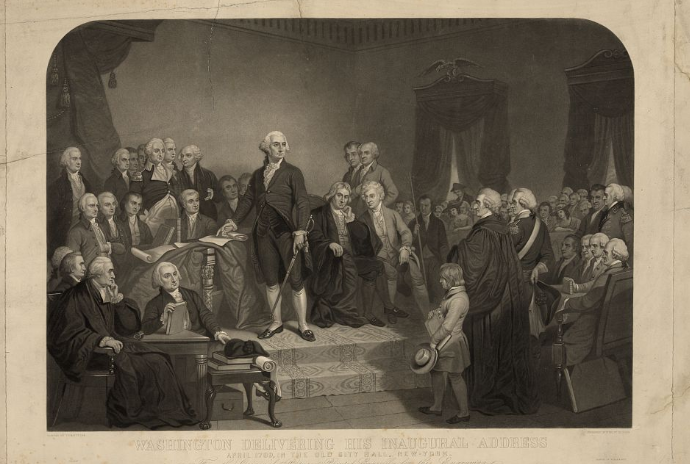
Although George Washington was overwhelmingly elected as President, the fact that Telfair received an electoral vote illustrates the respect he commanded among political leaders of the time.
Governor of Georgia
Edward Telfair’s influence in Georgia politics continued well after the Revolution.
He served three terms as Governor of Georgia, becoming one of the state’s most prominent early leaders.
During his time as governor, one of the most memorable events occurred when George Washington toured the southern states during his presidency.
While visiting Georgia, Washington was hosted by Telfair at one of his Augusta plantations, highlighting the close relationship between national and state leaders during the early years of the republic.
Family and Legacy
Edward Telfair accumulated considerable wealth through his mercantile enterprises, landholdings, and plantations. His success allowed him to provide a comfortable life for his family.

One of his most famous descendants was his daughter Mary Telfair, who later became one of Savannah’s most influential philanthropists.
Using the family fortune, she supported numerous charitable causes, including:
- Donating her mansion to create the Telfair Museums, the oldest art museum in the American South
- Funding the construction of a women’s hospital in Savannah
- Supporting the construction of Hodgson Hall, home of the Georgia Historical Society
Her philanthropic work helped preserve her father’s legacy and contributed greatly to Savannah’s cultural institutions.


Death and Burial
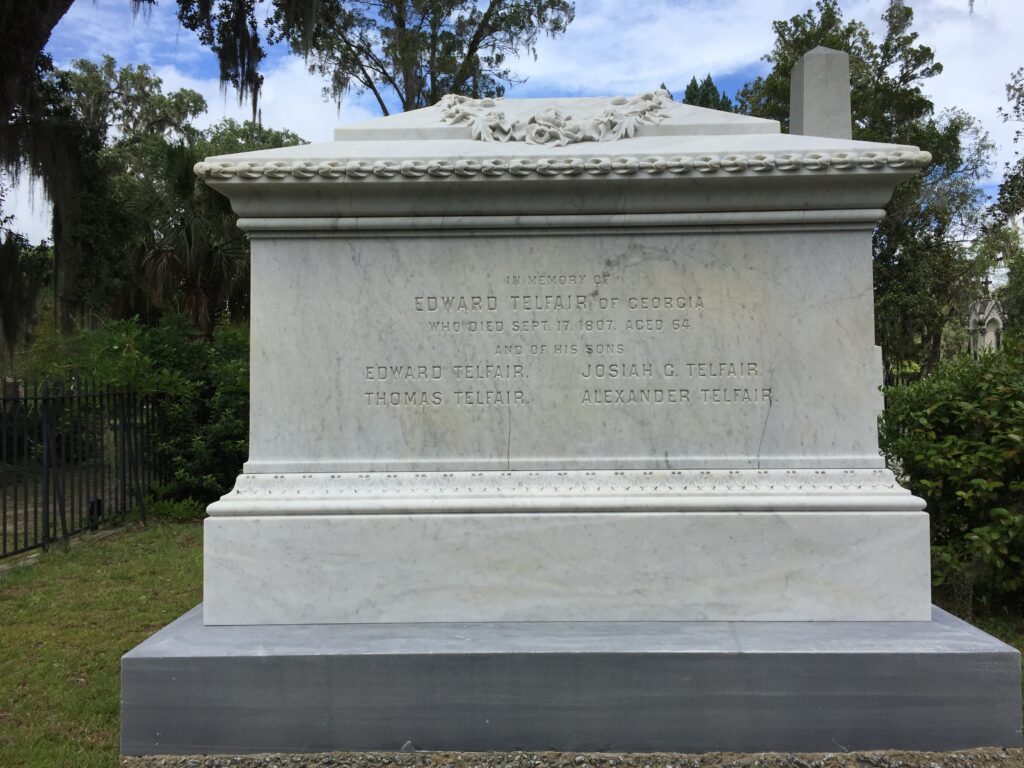
Edward Telfair died on September 17, 1807, at his residence in Savannah, Georgia.
He was initially buried at one of his plantations called Sharon, located near the city.
Later, in 1860, his remains were moved to Bonaventure Cemetery, one of Savannah’s most famous burial grounds.
His surviving daughters erected a memorial monument there to honor their father’s life and public service.
Honors and Historical Recognition
Telfair’s contributions to Georgia and the nation did not go unnoticed.
In the same year that he died, the state created Telfair County, naming it in his honor.
Additionally, a public square in Savannah was renamed Telfair Square to commemorate the family’s impact on the city.
These honors reflect the lasting respect that Georgians held for one of their most influential early leaders.
A Founding-Era Patriot
Edward Telfair’s life represents a remarkable journey—from a modest Scottish upbringing to the highest levels of leadership in the early United States.
His contributions included:
- Revolutionary activism with the Sons of Liberty
- Service on Georgia’s Council of Safety
- Membership in the Continental Congress
- Signer of the Articles of Confederation
- Supporter of the U.S. Constitution
- Three-term Governor of Georgia
Telfair risked his fortune and reputation for the cause of independence and helped guide Georgia through the uncertain years of the Revolution and early nationhood.
His story is a reminder that the American founding was shaped not only by native-born colonists but also by immigrants who believed deeply in the promise of the new nation.
Leave a Reply