William Whipple: Sailor, Merchant, Soldier, and Signer of the Declaration of Independence
Birth and Death
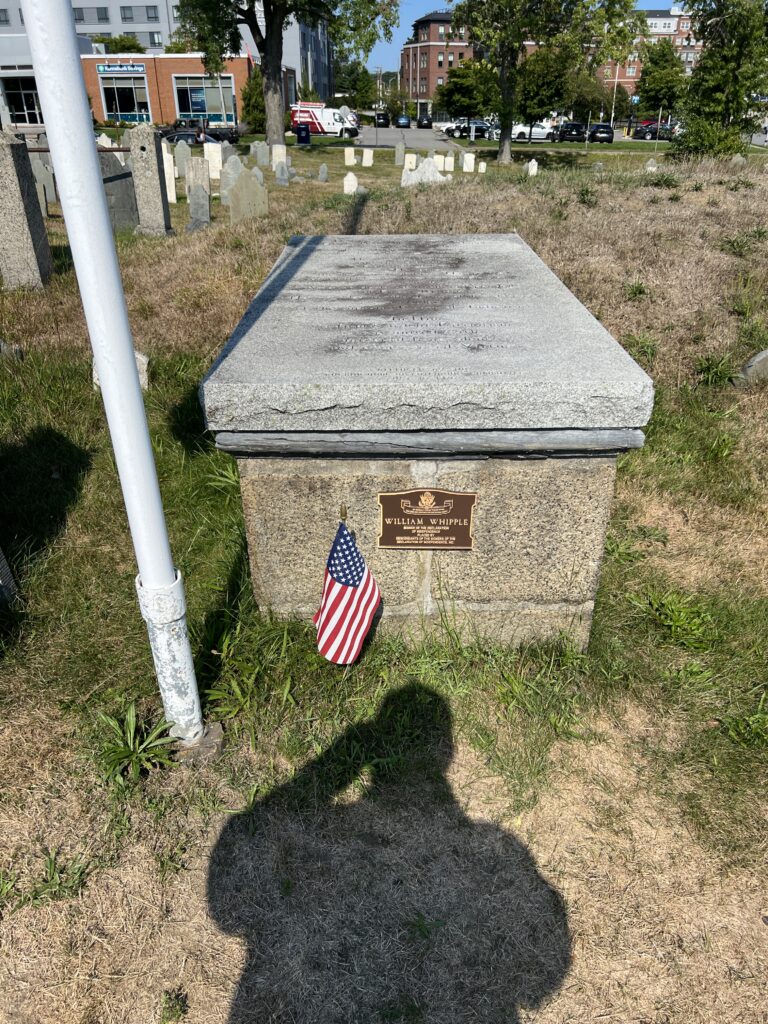
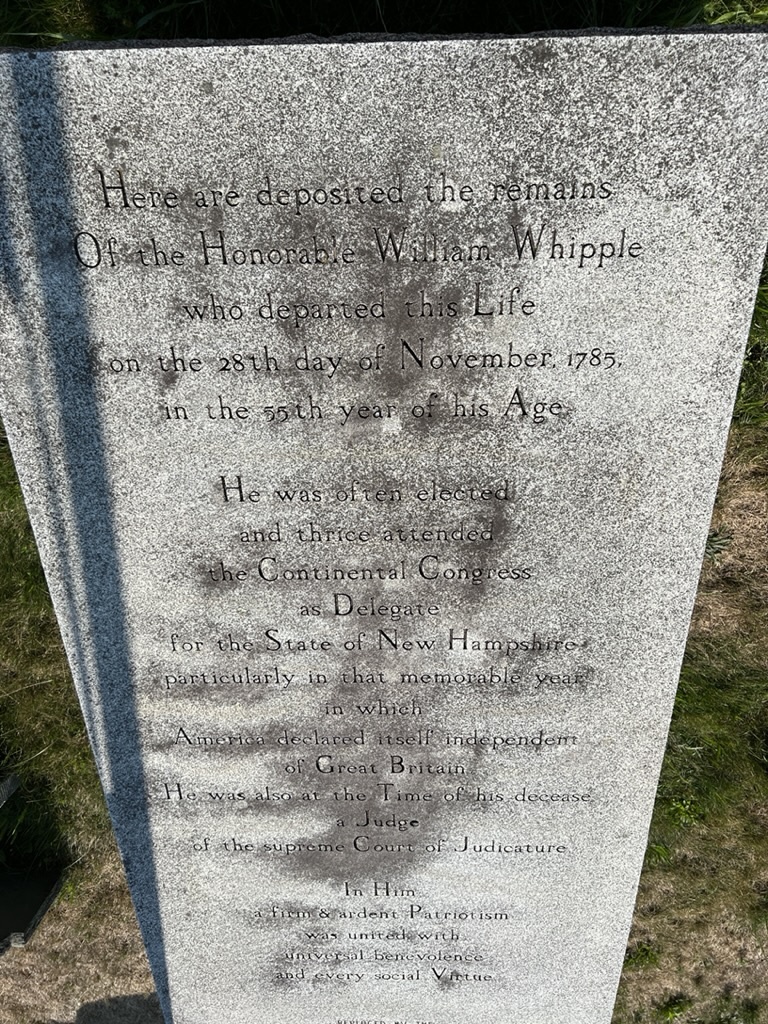
William Whipple was born in 1730 or 1731 in Kittery, Maine, which was then part of Massachusetts. He died on November 28, 1785, in Portsmouth, New Hampshire, at about 55 years old.
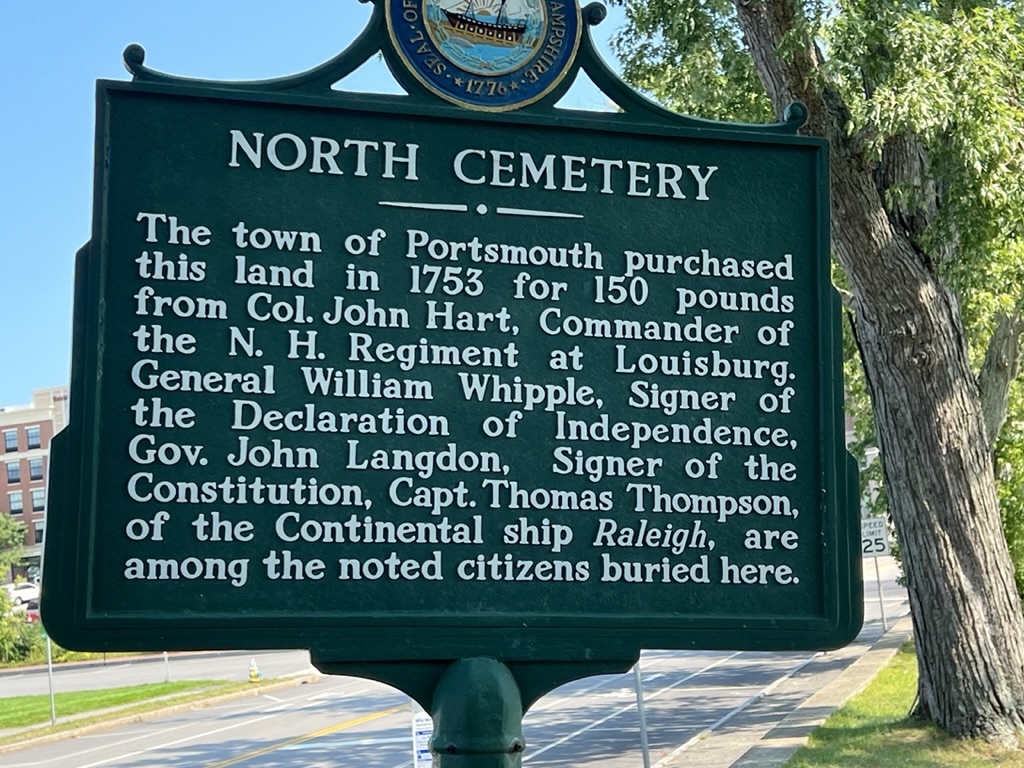
He is buried in North Cemetery in Portsmouth, the same cemetery where his formerly enslaved servant, Prince, is also buried.
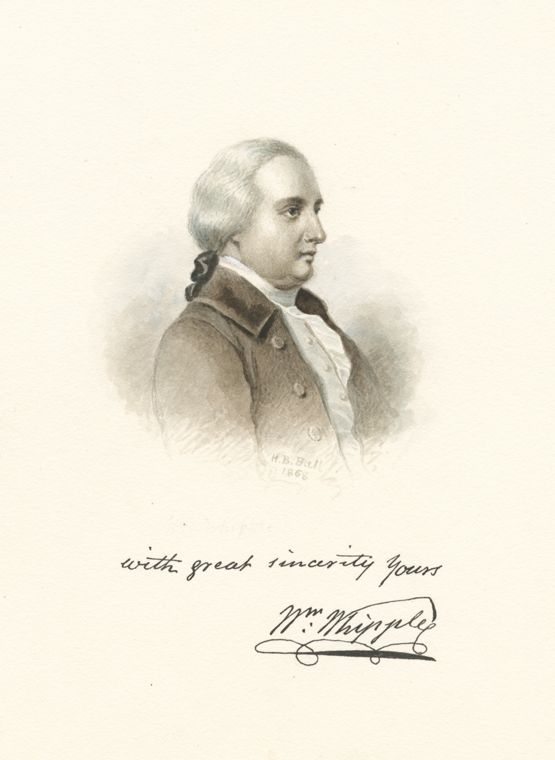
Whipple’s life led him from sailing the Atlantic to serving in the Continental Congress and fighting in a key campaign of the American Revolution. Unlike many Founding Fathers, he did not come from a privileged political background. Instead, he earned his place in public life through hard work, business success, strong character, and devotion to American independence.
Early Life and Family Background
William Whipple came from a family strongly connected to New England’s maritime life. His father, also named William Whipple, had roots in Ipswich, Massachusetts. He worked first as a maltster, what we might call a brewer today, and later became a sea captain. Eventually, he moved the family to Kittery.
The Whipple family’s American story reached back to Matthew Whipple, William’s great-great-grandfather, who left Bocking, England, and settled in Ipswich around 1638. On his mother’s side, William also came from a family tied to shipbuilding and seafaring. His mother, Mary Cutt, was the daughter of Robert Cutts, a successful shipbuilder in Kittery. The Cutts family had come from England as well, and by the time William was born, they had built both wealth and influence in the Portsmouth-Kittery region.
Whipple’s upbringing was important. He grew up surrounded by ships, trade, and the risks of Atlantic commerce. From a young age, he saw that the sea brought both opportunity and danger. This experience prepared him to make bold decisions later in his public life.
Education and Life at Sea
Whipple went to public school in his hometown and also had private lessons from Robert Gerrish, a Harvard graduate and family member. Although he did not have the elite education of some founders, he was well-educated. He learned enough to run a business, think clearly, write well, and later serve in Congress, the military, and as a judge.
After finishing school, Whipple sailed on one of his father’s merchant ships. Life at sea in the 1700s required discipline, courage, good judgment, and endurance. By age 21, he was captain of his own ship. He mostly sailed to the West Indies and became successful enough to build a large fortune before turning 30.
Around age 29, in 1759, Whipple stopped sailing and went into business with his two brothers on Bow Street in Portsmouth, New Hampshire. Like other colonial merchants, he became involved in the economic and civic life of the busy seaport. This change from ship captain to merchant also brought him closer to the political issues that would soon divide Britain and the American colonies.
Marriage and Life in Portsmouth
Whipple’s personal life experienced its share of disappointment before he married. According to the article, he once endured a painful courtship when a fiancée left him at the altar. Later, in 1767, he married his cousin, Catherine Moffat, who was 35 at the time.
Catherine came from another prominent Portsmouth family. She was the daughter of John Moffat and Catherine Cutt Moffat. In 1769, William and Catherine moved into the Moffat home, an impressive Georgian house in Portsmouth. Today, that home is known as the Moffatt-Ladd House and Garden, and it still functions as a historic house museum.
For anyone following the Signers Tour, this is one of those places where the story becomes tangible. Whipple wasn’t just a name on parchment. He lived, worked, entertained guests, planned, worried, and recovered from illness in real rooms that still survive today.
Entering the Patriot Cause
Though tensions rose between Great Britain and the colonies, Whipple became active in public life. People in Portsmouth trusted him because of his good judgment and strong character. The article says he was known for his honesty and integrity.
By 1764, Whipple was serving on a committee to prevent tea from being landed at Portsmouth. That detail is important because it shows his Patriot activity began well before the Declaration of Independence. He did not simply appear in Congress in 1776. He had already joined the colonial resistance to British policies.
In January 1775, Whipple represented Portsmouth at the provincial congress in Exeter, New Hampshire. The Congress met to choose delegates to the Continental Congress in Philadelphia. He again represented Portsmouth in the provincial congress that met in May 1775, and that body appointed him to one of the provincial committees of safety.
These committees were important during the Revolution. They helped the colonies organize resistance, keep order, support the militia, and get ready for possible war. Whipple was moving from being a merchant and community leader to becoming a key revolutionary figure.
William Whipple and the Declaration of Independence
In 1776, New Hampshire chose William Whipple to be a delegate to the Continental Congress. By then, the colonies were no longer merely protesting; war had already begun. The big question was whether the colonies would declare independence.
Whipple understood the seriousness of the moment. On January 7, 1776, he wrote to fellow New Hampshire patriot Josiah Bartlett:
“This year, my Friend, is big with mighty events. Nothing less than the fate of America depends on the virtue of her sons…”
This quote shows how important the year 1776 was. Whipple understood that America was at a turning point and that freedom would require sacrifice, discipline, and courage.
Whipple was present in Congress during the great debates over independence. He voted for independence on July 2, 1776, supported the Declaration of Independence on July 4, and signed the Declaration on August 2, 1776.
His story is especially powerful because of where he began. Thirty years earlier, Whipple had been a young sailor looking toward command of a vessel. Now he stood with the men who pledged their lives, fortunes, and sacred honor to the birth of a new nation. The article makes that contrast elegantly: the former cabin boy, whose early ambition had been to sign his name as commander on a ship’s crew list, now signed a document that carried his name into history.
This is one reason why Whipple’s story should be better known. He shows how talent and hard work could lead to success in colonial America. He may not be the most famous signer, but he was one of those who stepped up when it counted most.
Service in Congress
Whipple did not just sign the Declaration and fade away. In Congress, he became known for being active, persistent, and practical. He worked hard in the commissary and quartermaster departments. These jobs were not glamorous, but they were very important.
Armies cannot fight without food, clothing, ammunition, transportation, and organization. During the Revolution, supply problems constantly plagued the American cause. Whipple helped identify abuses and improve efficiency in those departments.
He also served on the Marine Committee. In that role, he became connected with one of the most famous naval names of the Revolution: John Paul Jones. In 1777, the Marine Committee appointed Jones to command the Ranger in Portsmouth, and Whipple was chosen to carry the authorization to him.
This detail connects Whipple to the larger military and naval history of the Revolution. He wasn’t only involved in politics; he also took part in the practical side of the war.
Brigadier General and the Saratoga Campaign
In the summer of 1777, while still a member of Congress, Whipple was appointed a brigadier general of the New Hampshire militia. New Hampshire also appointed the famous John Stark, who soon became known for his key role at the Battle of Bennington.
At that time, people in New Hampshire and nearby areas were afraid. The Americans had left Ticonderoga, and British General John Burgoyne was moving south toward Albany. His campaign threatened to separate New England from the other colonies. If he had succeeded, the Revolution could have ended very differently.
Whipple left Portsmouth to join General Horatio Gates. Before leaving, he visited Reverend Ezra Stiles, who later became president of Yale. Stiles recorded in his diary that Whipple showed him a draft of the new national constitution—the Articles of Confederation—which Whipple had brought home from Congress.
Whipple then served in the campaign that ended at Saratoga, one of the most important American victories of the war. At Saratoga, Whipple commanded New Hampshire troops. After Burgoyne surrendered, General Gates chose Whipple, along with Colonel Wilkinson, to meet with British officers and help settle the terms of capitulation.
This was a big responsibility. The victory at Saratoga changed the course of the Revolution. When France heard about Burgoyne’s surrender, they decided to become allies with the United States. This alliance was key to the American victory at Yorktown in 1781.
Prince Whipple and the Question of Liberty
One of the most memorable stories associated with William Whipple concerns Prince, an enslaved African man who attended him during the Saratoga campaign. According to tradition, Whipple encouraged Prince to fight bravely if called into action. Prince replied that he had no inducement to fight unless he had his liberty. Whipple then reportedly told him, “From this moment you are free.”
The article says that later research suggests Prince may not have been freed right away. Still, this story highlights a major contradiction of the American Revolution: people talked about liberty, but slavery still existed in the new country.
Whipple eventually freed his own slaves. Later, in a letter to Josiah Bartlett, he expressed hope that raising Black regiments in South Carolina might help lead to emancipation. He wrote that he hoped it would help bring “the blessings of Freedom to all humanity in America.”
This does not erase the contradiction, but it shows that Whipple grew and became more aware of moral issues. Like the country, he was part of an intricate and continuing effort to define what liberty really meant.
Rhode Island Campaign and Injury
In 1778, Whipple served again, this time under General John Sullivan in an effort to retake Rhode Island from the British. The plan depended on cooperation with the French fleet under Count d’Estaing, but the expected French support did not materialize. Sullivan eventually had to retreat.
During this campaign, Whipple was badly injured. While officers were having breakfast at General Sullivan’s quarters, British troops fired a cannon from nearby. The cannonball killed a horse outside, went through the house, and entered the room where the officers were sitting. The article says it shattered Whipple’s leg so badly that it had to be amputated right away.
This story may come from older sources, but either way, Whipple’s health got worse in the years after. His time in the military, public service, and physical pain affected him for the rest of his life.
Later Public Service
Even after the war years wore him down, Whipple continued to serve New Hampshire. In 1780, voters elected him to the state’s general assembly, and he won reelection several times.
In 1782, Robert Morris, who managed finances for Congress, made Whipple the receiver of public money for New Hampshire. This job was hard and unpopular. The new country needed money badly, but collecting it was difficult. Whipple faced many challenges in this role, and by 1784, his poor health forced him to stop.
Around the same time, he became a judge on the Superior Court of Judicature. He traveled the court circuits for a few years, but heart problems and other health issues made it hard for him to continue.
In the fall of 1785, while riding circuit, his condition worsened. He returned home to Portsmouth and remained confined to his room until his death on November 28, 1785.
Death, Burial, and Legacy
William Whipple died at about 55 years old. On December 9, 1785, the New Hampshire Gazette published a tribute, saying he was widely mourned and praising his patriotism, public service, generosity, kindness, and strength during hard times. The tribute ended with the memorable line that nature might look at him and say, “THIS WAS A MAN.”
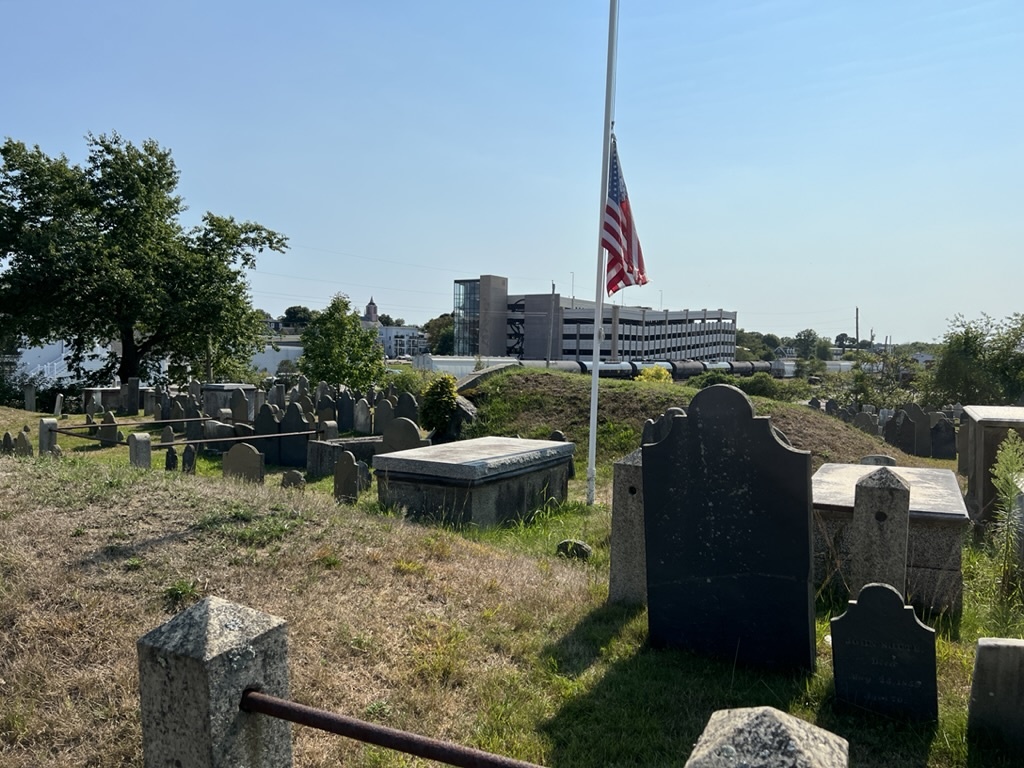
He was buried in North Cemetery in Portsmouth, New Hampshire. Prince, his former enslaved servant who also served as a soldier, is buried there too. Today, the cemetery is far more than a gravesite. It is a place to think about independence, military sacrifice, slavery, emancipation, and the ongoing meaning of freedom in America.
Whipple’s Portsmouth home, the Moffatt-Ladd House and Garden, remains open to the public as a historic house museum. Near the Washington Monument in Washington, D.C., his name also appears on one of the granite blocks at the memorial honoring the 56 signers of the Declaration of Independence.
William Whipple may not be the most famous signer, but his life was remarkable. He started as a sea captain, became a merchant, then a revolutionary leader, congressman, general, and finally a judge. He helped declare American independence, fought to defend it, helped win at Saratoga, and kept serving his state until his health failed.
His life reminds us that the Declaration was signed by real people, not just symbols. These men had complex lives, personal losses, public duties, and serious responsibilities. William Whipple truly earned his place among them.


Leave a Reply