Thomas Lynch Jr.
Signer of the Declaration of Independence (South Carolina)
Birth, Family, and Early Life (1749–1765)
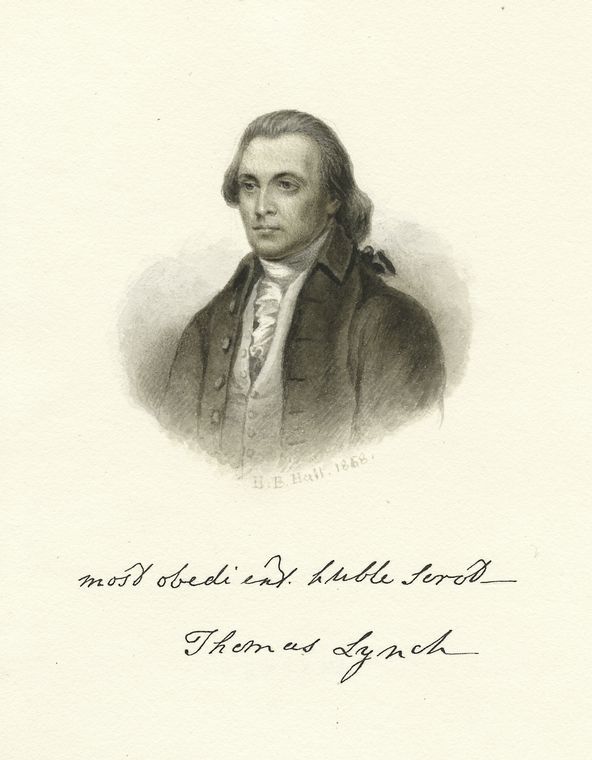
Thomas Lynch Jr. was born on August 5, 1749, in Prince George Parish, South Carolina, into a prominent and well-established plantation family. His father, Thomas Lynch Sr., was already a respected political figure and planter, and young Thomas grew up surrounded by influence, responsibility, and expectation.
The Lynch family owned large tracts of land along the Santee River, including the well-known Hopsewee Plantation. From the beginning, Thomas Jr. was raised in an environment that blended privilege with public duty. His father’s involvement in colonial politics clearly shaped his worldview early on.
Like many sons of elite colonial families, Thomas Jr. received a classical education. His early schooling took place in South Carolina, but his parents had bigger plans for him.
Education in England and Legal Training (1765–1772)
In his teenage years, Lynch was sent to England for advanced schooling—a common path for wealthy colonial families seeking to send their sons to the best education available.
He attended Eton College, one of England’s most prestigious schools. There, he received a rigorous education in classical studies, rhetoric, and leadership—skills that would later serve him in political life.
After Eton, Lynch continued his studies at the University of Cambridge, where he further developed his intellectual and political foundation.
Following his academic work, he began legal training at the Middle Temple, one of the four Inns of Court in London. This was a traditional route for those preparing for a legal or political career.
By the early 1770s, Lynch had completed his education and returned to South Carolina, ready to step into both business and public life.
Return to South Carolina and Early Public Role (1772–1775)
Back home, Thomas Lynch Jr. joined his father in managing the family’s plantation interests. But more importantly, he began entering the political world that his father had long been part of.
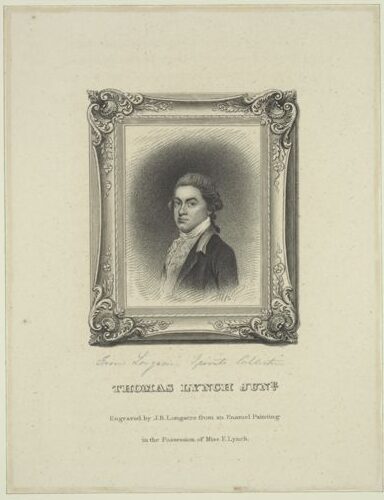
Tensions between the American colonies and Great Britain were escalating rapidly during this period. Issues like taxation, representation, and colonial rights were no longer theoretical debates—they were becoming flashpoints.
Lynch quickly aligned himself with the Patriot cause, supporting colonial resistance to British policies. His upbringing, education, and exposure to political life made him well-suited for leadership.
At the same time, he also served briefly in a military capacity, organizing and supporting efforts in South Carolina as the colonies prepared for potential conflict.
Illness and a Turning Point
In 1775, Lynch’s life experienced a dramatic turn. While serving in the militia during the early stages of the Revolutionary conflict, he contracted a severe illness—likely a form of malaria or a related fever common in the South Carolina lowcountry.
This illness was going to haunt him for the rest of his short life.
His health deteriorated significantly, and although he survived, he never fully recovered. From this point forward, Lynch lived with chronic weakness and declining physical strength.
Ironically, just as his health began to fail, his political importance rose.
The Continental Congress and a Unique Father-Son Moment (1776)
In 1776, both Thomas Lynch Jr. and his father, Thomas Lynch Sr., were selected to represent South Carolina in the Second Continental Congress.
This created a rare and remarkable moment in American history: a father and son serving together in Congress at one of the most critical times in the nation’s founding.
However, the moment was bittersweet.
Thomas Lynch Sr. had suffered a debilitating stroke before arriving in Philadelphia and was largely unable to participate in congressional proceedings. This left Thomas Jr.—young, inexperienced, and in fragile health—to carry the responsibility.
Despite these challenges, Lynch Jr. moved forward.
Signing the Declaration of Independence (1776)
When the time came to vote on independence, Lynch Jr. stood firmly with the Patriot cause.
On July 4, 1776, he joined fellow delegates in approving the United States Declaration of Independence.
Soon after, he signed the document, becoming one of the youngest signers at 26.
His signature also carries a unique historical footnote: because his father was incapacitated, Thomas Jr. effectively represented both himself and his family’s legacy at that moment. The elder Lynch had supported independence but was physically unable to sign.
In a way, Thomas Lynch Jr.’s signature stands for both men.
Declining Health and Resignation (1776–1777)
By late 1776, Lynch’s health had worsened considerably. The strain of travel, political work, and his lingering illness made it impossible for him to continue serving effectively.
In early 1777, he resigned from Congress and returned to South Carolina in hopes that rest and a change of environment might restore his health.
It never did.
Despite his youth, Lynch was now a man in steady physical decline.
Final Journey and Mysterious Death (1779)
In 1779, hoping to recover, Thomas Lynch Jr. and his wife set sail for the Caribbean, seeking a warmer climate and better conditions for his health.
They boarded a ship bound for the West Indies—but they never arrived.
The vessel was lost at sea, and Thomas Lynch Jr. disappeared without a trace. His death is generally recorded as occurring sometime in 1779, though no exact date or confirmed details exist.
He was just 30 years old.


Legacy and Historical Relevance
Thomas Lynch Jr.’s life was brief, but his role in American history remains meaningful.
He is remembered as:
- One of the youngest signers of the Declaration of Independence
- Part of a rare father-son delegation to the Continental Congress
- A representative of South Carolina during a critical moment in the nation’s founding
Because he died young and left no surviving children, his direct family line ended with him. In fact, he and his wife had made a unique agreement before their final voyage: heirs would inherit family property only if they adopted the Lynch name—an unusual yet telling reflection of their wish to preserve the family legacy.
His signature on the Declaration is also considered one of the rarest among collectors today, largely due to his short life and limited public record.
A Short Life, A Lasting Mark
When you step back and look at Thomas Lynch Jr.’s story, it’s one of unreached potential—but also silent courage.
He didn’t have decades to build a legacy. He didn’t serve long in Congress. He didn’t live to see the outcome of the Revolution.
But when the moment came—when the decision had to be made—he stood up, took his place, and signed his name.
This is one of those stories that reminds us:
Sometimes history isn’t formed by the longest lives…
but by those who show up when it matters most.
Leave a Reply