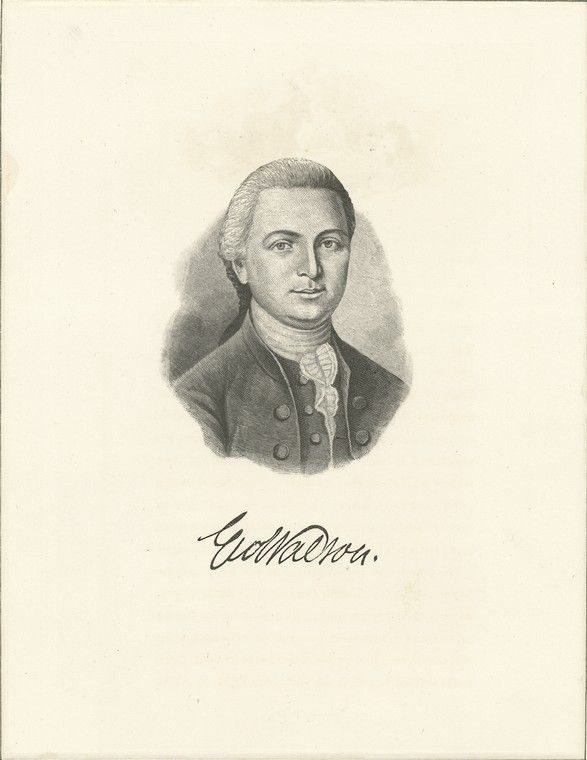
George Walton
Signer of the Declaration of Independence
Early Life and Humble Beginnings
George Walton’s life story is one of determination and self-made success. Unlike many of the Founding Fathers who came from wealth or privilege, Walton rose from very modest beginnings.
He was born around 1741 in Prince Edward County, near Farmville, Virginia, though historians debate the exact year. His parents, Robert and Mary Hughes Walton, were poor farmers. Tragedy struck early in his life when both parents died while he was still a boy, leaving him orphaned at about twelve years old.
With little support and no formal education, Walton was apprenticed to a local carpenter. His master valued labor over learning and even refused to allow Walton to use a candle to read at night. But the young apprentice refused to give up his desire to learn.
Instead, Walton gathered pieces of lightwood during the day, using them at night as makeshift torches to study and read. This remarkable determination showed early signs of the drive that would eventually carry him into the highest levels of public service.
By the late 1760s, Walton knew he wanted more from life than carpentry alone.
Moving to Georgia and Studying Law
In 1769, Walton moved south to the growing colony of Georgia, which was still relatively new. Founded in 1733 by James Oglethorpe, Georgia had originally been envisioned as a colony for the “worthy poor,” though the reality soon became more conventional.
Savannah, the colony’s main city, was developing rapidly. Walton recognized an opportunity there.
After arriving, he began studying law under Henry Young, a Savannah attorney. Walton devoted himself to learning the profession, and his hard work paid off.
In 1774, at about 33, he was admitted to the Georgia bar and began practicing law in Savannah.
Around this same time, he also became a Master Mason and joined Solomon’s Lodge in Savannah, a common network among civic leaders of the era.
Walton’s law practice quickly connected him with many of the colony’s leading political thinkers and patriots.
Entering the Revolutionary Cause
During the early 1770s, tensions between the American colonies and the British government were rising quickly. Georgia initially remained more cautious than many of the other colonies, and loyalty to the British Crown remained strong among its leadership.
Walton, however, quickly became an outspoken supporter of colonial rights.
He joined a group of patriots who gathered at the Liberty Pole at Tondee’s Tavern in Savannah to discuss resisting British policies that threatened colonial freedoms.
These meetings helped launch the Georgia Provincial Congress, an early revolutionary governing body.
Walton quickly rose to prominence within the movement. He was appointed:
- Secretary of the Georgia Provincial Congress
- President of the Council of Safety
These positions placed him among the leading voices pushing Georgia toward cooperation with the other colonies.
At first, Georgia hesitated to join the Continental Congress. But by 1776, revolutionary sentiment had grown strong enough that the Georgia Assembly appointed delegates to the Second Continental Congress.
George Walton was one of them.
Signing the Declaration of Independence
Walton traveled north to Philadelphia to represent Georgia in the Continental Congress.
Once there, he became a strong supporter of the movement toward independence. When the vote came in July 1776, Walton voted in favor of separation from Britain.
He then signed the Declaration of Independence, becoming one of the three signers from Georgia, alongside Button Gwinnett and Lyman Hall.
Signing the Declaration was no small risk. Those who signed were committing their “lives, fortunes, and sacred honor” to the revolutionary cause. For Walton, it meant fully dedicating himself to the success of the new nation.
He continued serving in Congress through much of the war, representing Georgia until 1778.
Military Service and Capture
Walton not only served politically during the Revolution. He also took on a military role.
In December 1778, he received a commission as a colonel in the Georgia militia during the British campaign to capture Savannah.
During the defense of the city, Walton was wounded in the thigh, knocked from his horse, and captured by British forces.
Fortunately, he was later exchanged as a prisoner in September 1779, allowing him to return to public service.
Governor of Georgia and National Leadership
Following his release, Walton’s political career continued to expand.
In 1779, he was appointed Governor of Georgia by the state legislature. His first term was brief, lasting only a few months before he returned to Congress.
Despite this short tenure, Walton remained deeply involved in shaping the young state’s government.
Over the following decades, he held numerous important positions, including:
- Delegate to the Continental Congress
- Governor of Georgia (two terms)
- Presidential Elector (1789)
- United States Senator (1798–1799)
- Judge and later Chief Justice of Georgia
He was particularly influential in Georgia’s judicial system. Walton served as Chief Justice of Georgia for fifteen years, holding the position until his death.
Civic Leadership and the Growth of Augusta
Walton eventually moved to Augusta, Georgia, which became an important center of political and economic life after the Revolution.
There, he played a key role in shaping the town’s development. Walton helped design plans to expand Augusta using a checkerboard street layout, inspired by both Savannah’s design and cities like Philadelphia.
He supported major civic improvements, including:
- A courthouse
- A jail
- A school system
Education remained one of Walton’s lifelong passions. He helped establish Richmond Academy and personally hired its first headmaster.
He also advocated for the placement of Franklin College—which later became the University of Georgia—in Augusta, though the final location was ultimately chosen as Athens.
Walton correctly predicted that Augusta would grow rapidly as settlers moved into Georgia’s interior after the Revolution.


Character and Personality
Contemporaries described George Walton as a man of strong intellect and strong personality.
Physically, he was small in stature but dignified and commanding. Friends admired his loyalty and determination, while critics sometimes noted his sharp temper and blunt opinions.
He was known to be:
- Energetic and ambitious
- Passionate about public service
- Loyal to his friends
- Occasionally sarcastic or stubborn
Despite some political controversies during his career, Walton remained widely respected by the citizens of Georgia.
His life reflected the Latin phrase “ut prosim” — “that I may serve.”
Family Life
George Walton married Dorothy Camber in Savannah in September 1778.
The couple had two sons:
- Thomas Camber Walton (1782–1803), who died unmarried
- George Walton Jr. (1787–1861)
Although Walton’s descendants continued for several generations, the direct family line eventually ended in 1925 with the death of his great-great-grandson.
Death and Burial
George Walton died on February 2, 1804, after suffering for years from painful attacks of gout, a disease common among many prominent men of the era.
He was originally buried in Rosney Cemetery in Augusta.
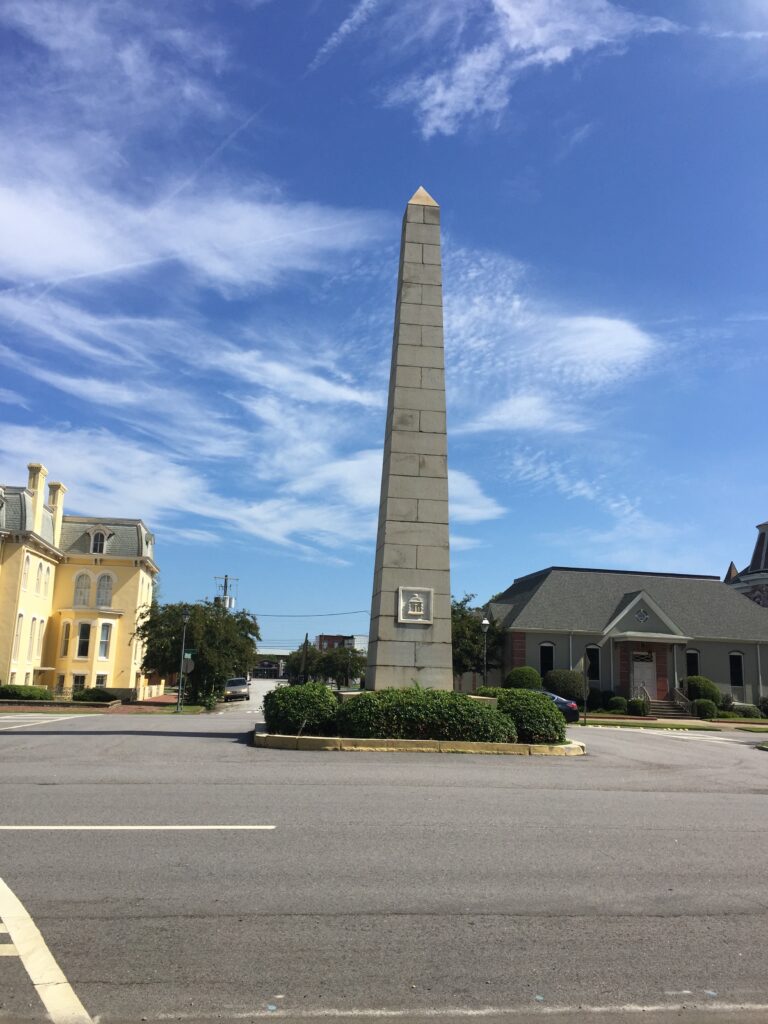
Later, when the Georgia Signers Monument was erected in Augusta in 1848, Walton’s remains were moved and reinterred beneath the impressive stone obelisk honoring Georgia’s three signers:
- George Walton
- Button Gwinnett
- Lyman Hall
The monument still stands today as one of Augusta’s most important historical landmarks.
Legacy
George Walton’s journey—from orphaned apprentice to national leader—is one of the most remarkable stories among the signers of the Declaration.
His legacy lives on in many places across Georgia, including:
- Walton County, Georgia
- Streets and schools named in his honor
- Meadow Garden, his home in Augusta, is preserved today as a historic museum operated by the Daughters of the American Revolution
Perhaps the most fitting tribute to Walton’s life is his lifelong dedication to education and opportunity. The boy who once read by firelight because he was denied a candle ultimately helped build schools, courts, and government institutions that shaped an entire state.
From humble beginnings, George Walton became one of the most influential citizens in Georgia’s early history—and a proud signer of America’s Declaration of Independence.
Leave a Reply