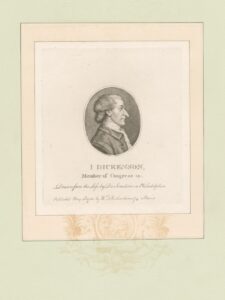
John Dickinson (1732–1808)
Statesman, political writer, soldier, and early constitutional thinker
A Voice of Reason in a Revolutionary Age
John Dickinson was born on November 8, 1732, at Crosiadore, his family’s plantation on Maryland’s Eastern Shore. When he was still a boy, the Dickinson family moved to Delaware, where he was educated at home by tutors. From an early age, he was groomed for a life in public service.
In 1750, Dickinson began studying law in Philadelphia. A few years later, he continued his legal training in London at the prestigious Middle Temple, one of England’s four Inns of Court. He was admitted to the bar in 1757 and returned to the American colonies to practice law. His time in England shaped his lifelong respect for the British constitutional system—a belief that would strongly influence his political positions during the Revolution.
Early Political Career

Dickinson entered public life in 1759 when he was elected to Delaware’s provincial legislature. Within a year, he rose to the position of Speaker. In 1762, he was elected to the Pennsylvania Assembly, where he became involved in heated disputes over colonial governance and property rights.
By the mid-1760s, tensions between Britain and the colonies were growing. Dickinson emerged as a leading voice for colonial rights, but unlike some of his more radical contemporaries, he believed those rights should be defended within the framework of the British Constitution rather than through outright independence.
In 1765, he served as a delegate to the Stamp Act Congress, where he drafted the Declaration of Rights and Grievances. In that document, he acknowledged Parliament’s authority over the colonies in certain matters, but insisted that taxation without representation violated the colonists’ constitutional rights.

“Letters from a Farmer in Pennsylvania”
Dickinson became widely known throughout the colonies and even in Europe in 1768 with the publication of his famous “Letters from a Farmer in Pennsylvania.” Originally printed as a series of newspaper essays, the letters clearly and persuasively explained why Parliament had no right to tax the colonies for revenue.
The essays argued that while Parliament could regulate trade, it could not impose taxes simply to raise money. Dickinson urged peaceful resistance—especially non-importation of British goods—rather than violence. The writings were immensely popular, helping unify colonial opinion and shape the political thinking of the time.
Through these letters, Dickinson became one of the most respected political thinkers in the colonies. Many regarded him as the leading spokesman for American constitutional rights in the years just before the Revolution.
Reluctant Revolutionary
Despite his firm defense of colonial liberties, Dickinson was cautious about breaking away from Britain. He believed reconciliation was still possible and feared the consequences of a complete rupture with the mother country.
He served as a delegate to both the First and Second Continental Congresses. There, he worked to articulate colonial grievances and to support measures such as non-importation agreements. However, he continued to push for peaceful solutions.
In the Second Continental Congress, Dickinson rewrote Thomas Jefferson’s original draft of the Declaration of the Causes and Necessity of Taking Up Arms, softening its tone. He also authored the Olive Branch Petition—a final attempt to reconcile with King George III and avoid full-scale war.
When the debate over independence came to a vote in July 1776, Dickinson spoke passionately against it. He believed the colonies were not yet prepared for independence and that separation would bring unnecessary hardship.
When independence was declared anyway, Dickinson did something that revealed the depth of his patriotism:
He joined the Continental Army and served as an officer, despite his earlier opposition to the Declaration.
War Service and Executive Leadership
After his military service, Dickinson returned to political life. He rejoined Congress in 1779 and soon moved into executive roles.
- Governor (President) of Delaware: 1781–1783
- Governor (President) of Pennsylvania: 1782–1785
For about a year, he simultaneously served as the chief executive of both states—an unusual distinction in American history.
During this period, he also helped found Dickinson College in Carlisle, Pennsylvania, in 1783. It was the first college chartered in the newly independent United States.
Role in the Constitutional Convention
In 1787, Delaware sent Dickinson to the Constitutional Convention in Philadelphia as a delegate. There, he argued for a strong national legislature and a relatively weak executive, drawing heavily on his understanding of the British constitutional system.
Although not all of his ideas were adopted, Dickinson strongly supported the final Constitution. He wrote a series of essays known as the “Fabius Letters,” which helped persuade both Delaware and Pennsylvania to ratify the new Constitution. These states became the first and second, respectively, to approve it.
Later Years and Death
After the Constitution was ratified, Dickinson gradually withdrew from national politics. He returned to Delaware, where he helped write the state constitution and served briefly as a state senator.

Even in retirement, he remained engaged in public affairs. He spoke out against the Jay Treaty with Britain in 1795 and later warned of the dangers posed by Napoleon’s rise to power. He even advocated for a naval alliance with Britain to counter French expansion.
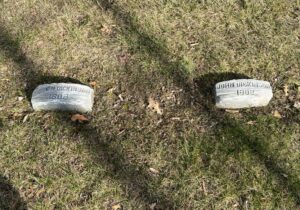
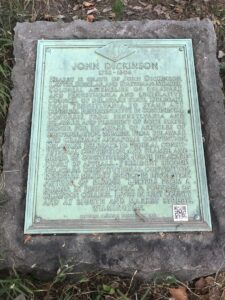
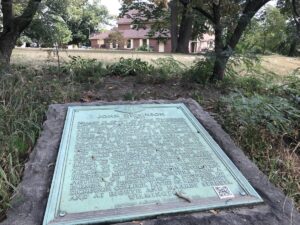
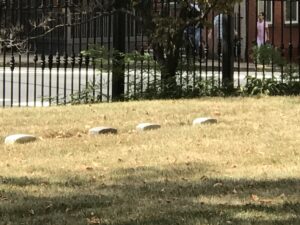
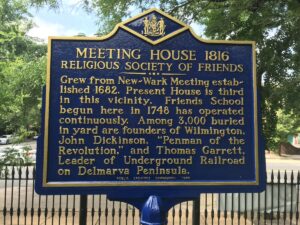
John Dickinson died on February 14, 1808, in Wilmington, Delaware, at the age of 75.
Profession and Public Service Summary
Born: November 8, 1732 – Crosiadore, Maryland
Died: February 14, 1808 – Wilmington, Delaware
Profession:
- Lawyer
- Political writer and pamphleteer
- Statesman
- Military officer in the Continental Army
Major Government Service:
- Delegate, Stamp Act Congress (1765)
- Delegate, First and Second Continental Congresses
- Officer, Continental Army
- Delegate, Continental Congress (1779)
- Governor (President) of Delaware (1781–1783)
- Governor (President) of Pennsylvania (1782–1785)
- Delegate, Constitutional Convention (1787)
- State senator in Delaware
SignersTour Perspective
John Dickinson is often remembered as the “Penman of the Revolution.” His writings helped unify colonial resistance, yet he remained cautious about independence until the very end. Though he did not sign the Declaration of Independence, his influence on the Revolutionary cause—and later on the Constitution—was profound.
He represents a type of Founder sometimes overlooked: the thoughtful moderate who valued order, law, and careful constitutional development. Dickinson’s life reminds us that the path to independence was neither unanimous nor simple, but rather marked by debate, conviction, and personal sacrifice.
Leave a Reply