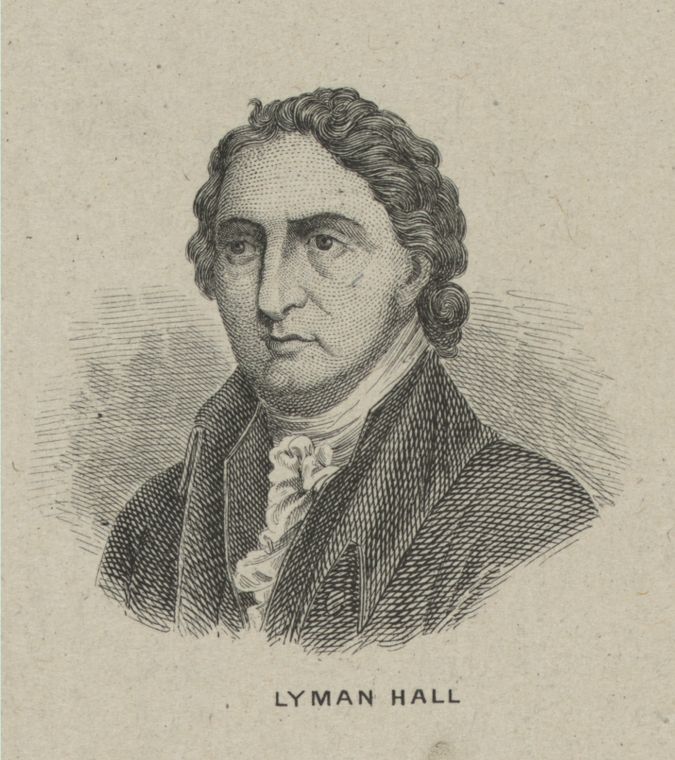
Lyman Hall (1724–1790)
Physician, Patriot, and Signer of the Declaration of Independence
Birth and Family Background
Lyman Hall was born on April 12, 1724, in Wallingford, Connecticut, a small colonial town with strong Puritan roots. He was the fourth of eight children born to John Hall (1692–1773) and Mary Street Hall (1698–1778). The Hall family had deep colonial roots; Lyman was a fifth-generation descendant of John Hall, who emigrated from Coventry, England, to New England in the early 1600s.
His mother’s side of the family was also steeped in religious and intellectual tradition. Mary Street was descended from Reverend Nicholas Street, an Oxford-educated minister who settled in New Haven during the early colonial period. With such a heritage, it is not surprising that young Lyman grew up in a household that valued education, faith, and civic responsibility.
These influences helped shape the character of the man who would later become one of Georgia’s most respected physicians and political leaders during the American Revolution.
Education and Early Career
Hall attended Yale College, graduating in 1747 as part of a class of twenty-eight students. At that time, Yale was closely connected to the Congregational church, and many graduates entered the ministry. Following that path, Hall began studying theology under the guidance of his uncle, Reverend Samuel Hall.

By 1749, he had begun preaching in Bridgeport, Connecticut, and was eventually ordained as a minister.
However, Hall’s early ministerial career did not go smoothly. In 1751, accusations of immoral conduct were brought against him before a church council. Hall confessed to the charges and was dismissed from his position. Though the council later restored him to good standing, the incident clearly altered the course of his life.
Rather than continue in the ministry, Hall decided to pursue a new profession—medicine. After studying medical science, he earned a Doctor of Medicine and began practicing as a physician in Wallingford.
His personal life during this period also included tragedy and change. In 1752, Hall married Abigail Burr, but she died only a year later. Soon afterward, he married Mary Osborn of Fairfield, Connecticut. The couple would have one son, John Hall, who unfortunately died without children in 1791.
Move to the Southern Colonies
During the mid-1700s, a group of Congregational Puritans from New England had established a thriving settlement called Dorchester in South Carolina, near Charleston. News of their success and prosperity spread northward and attracted others from New England who shared their religious outlook.
Around 1754 or 1755, Lyman Hall joined a group of settlers moving south to this community. The transition marked a major shift in his life—from a traditional New England upbringing to the frontier conditions of the southern colonies.
Not long after, some members of the Dorchester community began looking even farther south toward Georgia, the youngest of the American colonies. Large areas of fertile land were available there, particularly in what became the Midway District of St. John’s Parish, now Liberty County, Georgia.

Hall followed his friends to this new settlement and purchased a small plantation north of the Midway Meeting House. The region was rich in natural resources, but also difficult and dangerous. Swamps and marshes surrounded the area, bringing frequent outbreaks of malaria and other diseases.
For Dr. Hall, however, this environment meant opportunity. Illness was common, and his services as a physician were desperately needed.
A Respected Physician and Community Leader
Hall quickly earned a reputation as one of the leading physicians in coastal Georgia. Known for his compassion and bedside manner, he became widely respected throughout the Midway and Sunbury communities.
The town of Sunbury, located on high ground overlooking the Midway River, soon became an important local center. Hall purchased property there and built a summer residence. His medical practice expanded as he traveled throughout the surrounding countryside, treating patients.
Physically described as tall, well-proportioned, and personable, Hall possessed the qualities of a natural leader. His education, culture, and calm demeanor made him a respected voice within the community.
These qualities would soon draw him into the growing political conflict between the American colonies and Great Britain.
Rising Political Tensions in Georgia
As tensions between Britain and the colonies escalated in the 1760s and early 1770s, Georgia remained somewhat divided. Unlike many other colonies, Georgia had received substantial financial assistance from the British government during its early years. As a result, many citizens and officials remained loyal to the Crown.
However, the residents of St. John’s Parish, where Hall lived, were largely descendants of New England Puritans and tended to sympathize with the cause of colonial liberty.
Hall quickly emerged as one of the leading voices in this movement. His background as a preacher likely contributed to his ability to speak clearly and persuasively about the political issues of the day.
He became closely associated with other revolutionary figures, including Button Gwinnett, who lived nearby on St. Catherine’s Island. Together, they pushed for Georgia to join the other colonies in resisting British authority.
Delegate to the Continental Congress
Georgia’s royal governor initially delayed sending representatives to the Continental Congress, which frustrated many colonists.
Determined to make their voices heard, the people of St. John’s Parish decided to act independently. In 1775, they elected Lyman Hall as their delegate to represent them in Philadelphia.
On May 13, 1775, Hall arrived at the Continental Congress and presented his credentials. He was unanimously accepted as a delegate representing St. John’s Parish.
Because Georgia had not yet officially joined the Congress, Hall initially refrained from voting on matters decided by colony-wide vote. Nevertheless, his presence ensured that Georgia’s pro-independence citizens had a voice in the national discussions.
Soon afterward, Georgia formally joined the Congress, and Hall became one of its official representatives.
Signing the Declaration of Independence
When the historic vote for independence came on July 2, 1776, Lyman Hall was 52 years old.
He voted in favor of independence and later signed the Declaration of Independence on August 2, 1776, alongside fellow Georgian signers Button Gwinnett and George Walton.
Hall continued to serve in Congress until 1780, helping guide the young nation through the difficult early years of the Revolutionary War.
War Hardships and Exile
The war eventually reached Georgia in force. In 1780, British troops captured Savannah and spread throughout the surrounding region, including Sunbury and Liberty County.
At General George Washington’s advice, Hall evacuated Georgia with his wife and son and returned temporarily to Connecticut.
The move came at great personal cost. British forces confiscated Hall’s property, including his home, plantation, and enslaved laborers. The losses were substantial.
He remained away from Georgia for nearly two years before returning in 1782, after the British withdrew.
Governor of Georgia
Despite his losses, Hall resumed his medical practice in Savannah. His reputation and leadership soon led to another call for public service.
In January 1783, he was elected Governor of Georgia.
The state was in terrible condition after years of war. Homes had been destroyed, farms abandoned, and the economy devastated. Hall’s administration focused on rebuilding the state and restoring stability.
During his one-year term, he worked on:
- Establishing land offices and organizing land sales
- Managing the public debt
- Rewarding Revolutionary soldiers with land grants
- Negotiating peace and cooperation with the Cherokee and Creek nations
- Rebuilding courts and civil government
One of Hall’s most important contributions came in education. He urged the Georgia legislature to promote schools and institutions of learning. His recommendation helped pave the way for the founding of the University of Georgia, chartered in 1785, one of the earliest public universities in the United States.
Final Years and Death
After completing his term as governor, Hall returned to private life and continued practicing medicine in Savannah.
In 1790, he moved to Burke County, Georgia, where he purchased a plantation overlooking the Savannah River.
It was there that Lyman Hall died on October 19, 1790, at the age of 66.
He was survived by his wife, Mary, and their son, John, although both would die within a year of his death.


Burial and Legacy
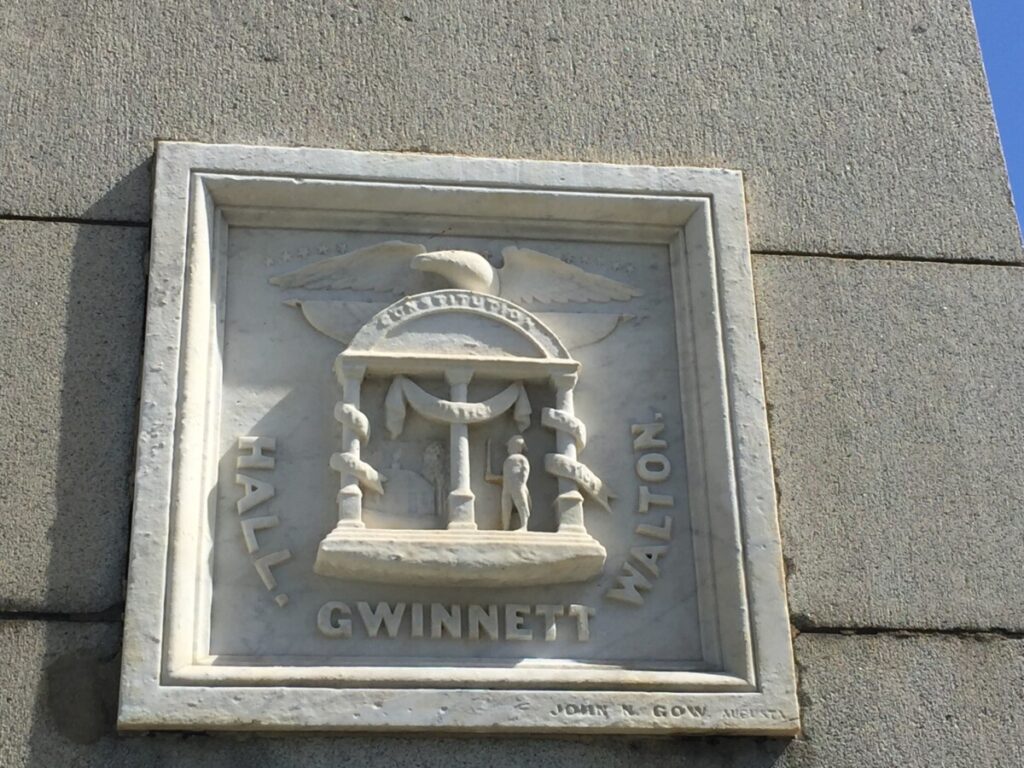
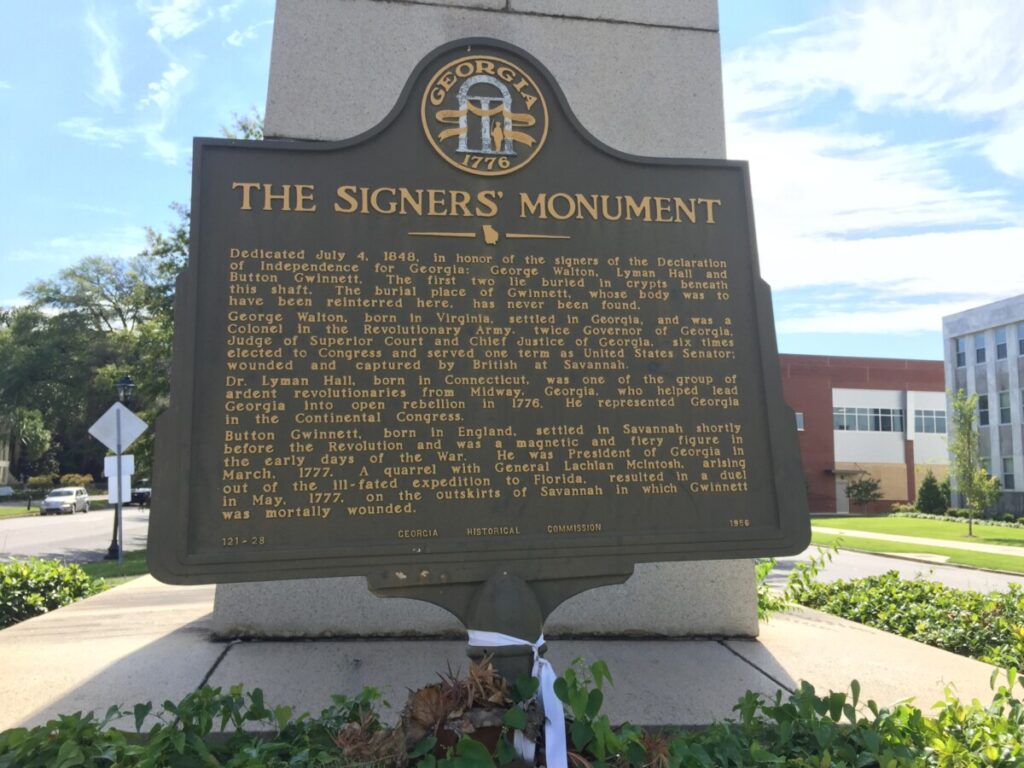
Hall was originally buried in a brick vault on his plantation overlooking the Savannah River. In 1848, however, his remains were moved to Augusta, Georgia, where they were reinterred beneath a monument honoring Georgia’s three signers of the Declaration of Independence:
- Lyman Hall
- Button Gwinnett
- George Walton
His legacy continued in other ways as well. Hall County, Georgia, established in 1818, was named in his honor. His birthplace, Wallingford, Connecticut, also commemorates him with a cenotaph and a high school named after him.
Today, his name appears among the fifty-six signers commemorated in monuments and memorials across the United States, including the Signers Memorial near the Washington Monument in Washington, D.C.
Remembering Lyman Hall
Lyman Hall’s life is a remarkable story of reinvention and service. He began his career as a minister, became a respected physician, emerged as a political leader in revolutionary Georgia, and ultimately signed one of the most important documents in American history.
His journey—from a Connecticut preacher to a Georgia patriot—illustrates how the American Revolution drew together individuals from very different backgrounds in the shared pursuit of liberty.
Though he left no direct descendants, Hall’s influence remains visible in the institutions he helped shape and the nation he helped bring into existence.
Leave a Reply