Signer of the Declaration of Independence, the Articles of Confederation, and the Continental Association from the State of Massachusetts
Robert Treat Paine
From Boston Birth to Revolutionary Legacy
If you were standing on School Street in Boston in the spring of 1731, you’d be just steps away from the birthplace of Robert Treat Paine—a man who would help guide America from colony to country and then spend decades helping it govern itself.
Robert Treat Paine was born on March 11, 1731, and baptized at the Old South Church, already placing him at the center of Boston’s civic and religious life. He came from a deeply established New England family. His father, Reverend Thomas Paine, was a Harvard-educated minister turned merchant, and his mother, Eunice Treat, descended from prominent colonial clergy and leaders. Even his middle name, “Treat,” was a nod to that heritage. Through his mother’s line, Paine was also a descendant of Stephen Hopkins, the Mayflower passenger and signer of the Mayflower Compact.
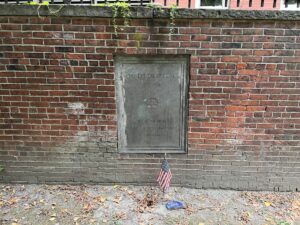
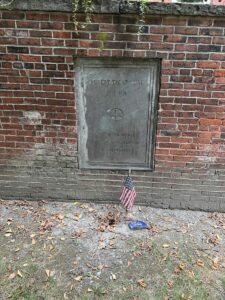
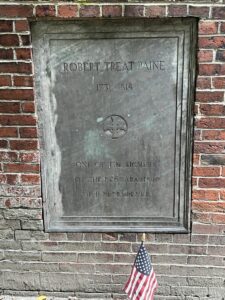
A gifted student, Paine graduated at the top of his class from Boston Latin School and entered Harvard at just fourteen. His future looked comfortable—until his father lost his fortune just as Robert graduated. Suddenly, on his own, Paine tried teaching, seafaring, and even led a whaling expedition. None of it made him rich, but it made him resourceful.
Eventually, he turned to the law, where he found his footing. By the late 1750s, Paine was practicing throughout Massachusetts and settled in Taunton, becoming a respected attorney, town leader, and justice of the peace. In 1770, he married Sally Cobb, whose family was well-connected to the Revolutionary cause. Together they raised eight children, and despite public pressures and personal losses, the family remained central to Paine’s life.
Politically, Paine’s journey mirrored that of many cautious patriots. He initially hoped tensions with Britain could be resolved. That changed after the Boston Massacre in 1770, when Paine served as lead prosecutor against the British soldiers, while future fellow signer John Adams defended them. Though the soldiers were largely acquitted, the trial cemented Paine’s reputation and sharpened colonial resolve.
By 1774, Paine was a key figure in Massachusetts resistance efforts and soon took his seat in the Continental Congress. Even then, he supported one last attempt at peace, signing the Olive Branch Petition in 1775. When the King rejected it, Paine accepted that independence was inevitable.
On July 4, 1776, Paine voted for—and later signed—the Declaration of Independence. His diary entry that day was understated, but the act itself was anything but.
After independence, Paine helped build the new nation. He served as Speaker of the Massachusetts House, became the state’s first Attorney General, and later a Supreme Judicial Court justice. Most notably, he prosecuted a case in 1783 that effectively ended slavery in Massachusetts—the first state to do so.
Robert Treat Paine died on May 11, 1814, and was buried in the Granary Burying Ground, just two blocks from where he was born. Few Founders lived a life so geographically—and historically—complete. His story reminds us that independence didn’t end in 1776; for Paine, it was a lifelong commitment to law, family, and the American experiment.
Leave a Reply