Signer of the Declaration of Independence, Articles of Confederation & the Continental Association from Massachusetts
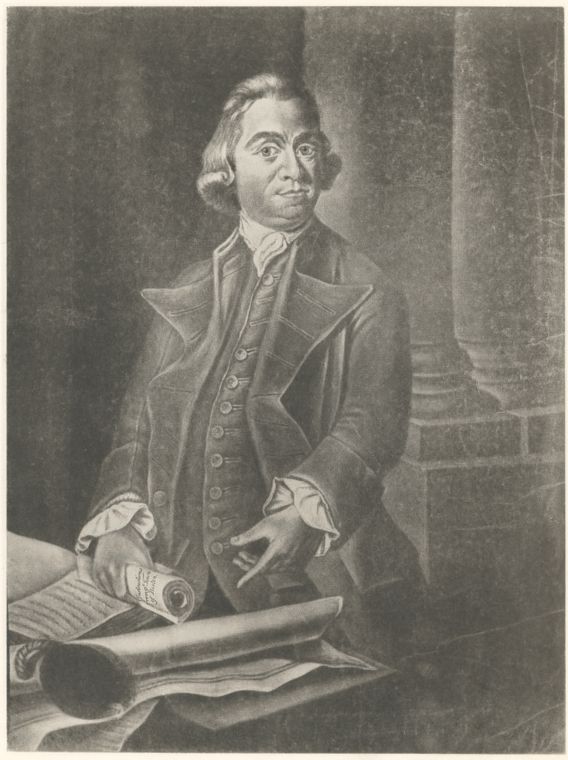
The Miriam and Ira D. Wallach Division of Art, Prints and Photographs: Print Collection, The New York Public Library. “Samuel Adams.” The New York Public Library Digital Collections. 1800 – 1910. https://digitalcollections.nypl.org/items/df649f10-c52e-012f-5c34-58d385a7bc34
Samuel Adams, one of the most influential voices behind American independence, was born on September 22, 1722, in Quincy, Massachusetts, into a large and respected Puritan family. He was the eldest of twelve children born to Samuel Adams Sr., a prosperous brewer and member of the Massachusetts Assembly, and his wife, Mary Fifield Adams. His ancestry traced back to early Pilgrim settlers, and those roots shaped his strong religious faith and belief in self-government.
Adams was described as a man of medium height, muscular build, gray eyes, and a warm, genial manner. Though friendly and loyal in personal relationships, he was intensely devoted to public causes. He first married Elizabeth Checkley in 1749, and they had one son and one daughter before her death in 1757. In 1764, he married his second wife, Elizabeth Wells.
He entered Harvard College in 1736 and earned his Master of Arts degree in 1743. His thesis asked whether it was lawful to resist a ruler if the commonwealth could not otherwise be preserved—a question that foreshadowed his life’s work. After graduation, he studied law and tried business, but with little success. When his parents died, he inherited a home and brewery, yet poor business decisions and his constant focus on public affairs left him nearly bankrupt. His second cousin John Adams famously described him as a man of excellent character who was perhaps too attentive to public matters and not enough to his own family and finances.
Politics was Samuel Adams’ true calling. By the early 1760s, as tensions with Great Britain grew, he became a leading critic of British taxation policies. In 1763, he helped draft an important document declaring that Parliament had no right to tax the colonies without their consent. This principle—“no taxation without representation”—would soon become a rallying cry across America.
From 1765 to 1774, Adams served as clerk of the Massachusetts legislature, where he drafted many of its official papers. He played a major role in organizing resistance to the Sugar Act and Stamp Act. By 1770, his followers were known as the Sons of Liberty. After the Boston Massacre that year, Adams helped lead a public meeting and persuaded the governor to remove British troops from Boston, preventing further violence.
In 1773, Parliament passed the Tea Act. Adams helped organize opposition, declaring that anyone aiding the tea trade was an enemy of America. When the governor refused to send the tea ships back to England, the famous Boston Tea Party followed, with colonists dumping the tea into Boston Harbor. Britain responded by closing the port, which only united the colonies more strongly.
In 1774, Adams was chosen as a delegate to the First Continental Congress. British authorities considered him a leading agitator, and General Thomas Gage even excluded him from a general pardon. On the night of April 18, 1775, Adams and John Hancock were staying in Lexington when Paul Revere warned them of the British approach. They escaped just before the fighting at Lexington and Concord began the Revolutionary War.
Adams served in the Continental Congress from 1774 to 1781. He was a strong advocate for independence and believed reconciliation with Britain was impossible. On July 2, 1776, he voted in favor of independence, and on August 2, 1776, he signed the Declaration of Independence, the document that formally announced the American colonies’ separation from Great Britain.
He also served on the committee that drafted the Articles of Confederation and signed that document on November 15, 1777, helping create the first national government of the United States.
After leaving Congress in 1781, Adams returned to Massachusetts and continued in public service. He served in the Massachusetts State Senate from 1781 to 1788, presiding over that body. He was also a delegate to the Massachusetts convention that ratified the U.S. Constitution in 1788. In 1789, he was elected lieutenant governor of Massachusetts, serving until 1794. Upon the death of Governor John Hancock, Adams became governor, serving from 1794 to 1797, when he retired from public office.
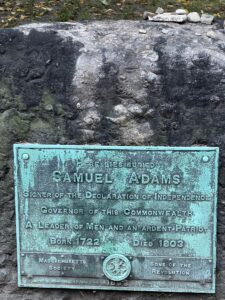
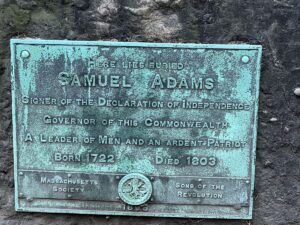
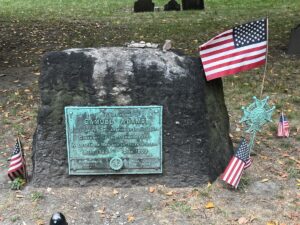
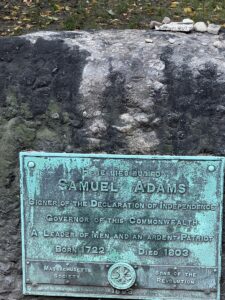
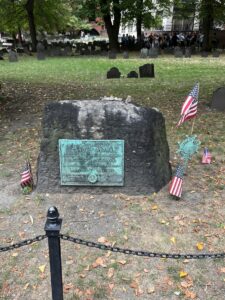
Despite his immense influence and lifelong public service, Adams lived much of his life in relative poverty. He died on October 2, 1803, at the age of 82. He was buried in the Old Granary Burying Ground in Boston, not far from the site of the Boston Massacre—one of the events he helped shape. Later, Massachusetts honored him by placing a statue in Statuary Hall in the U.S. Capitol, making him one of the few signers of the Declaration to receive that distinction.
Samuel Adams left a legacy as one of the Revolution’s most determined patriots—a man who sacrificed personal wealth and comfort for the cause of liberty and helped shape the founding documents of the United States.
Leave a Reply